



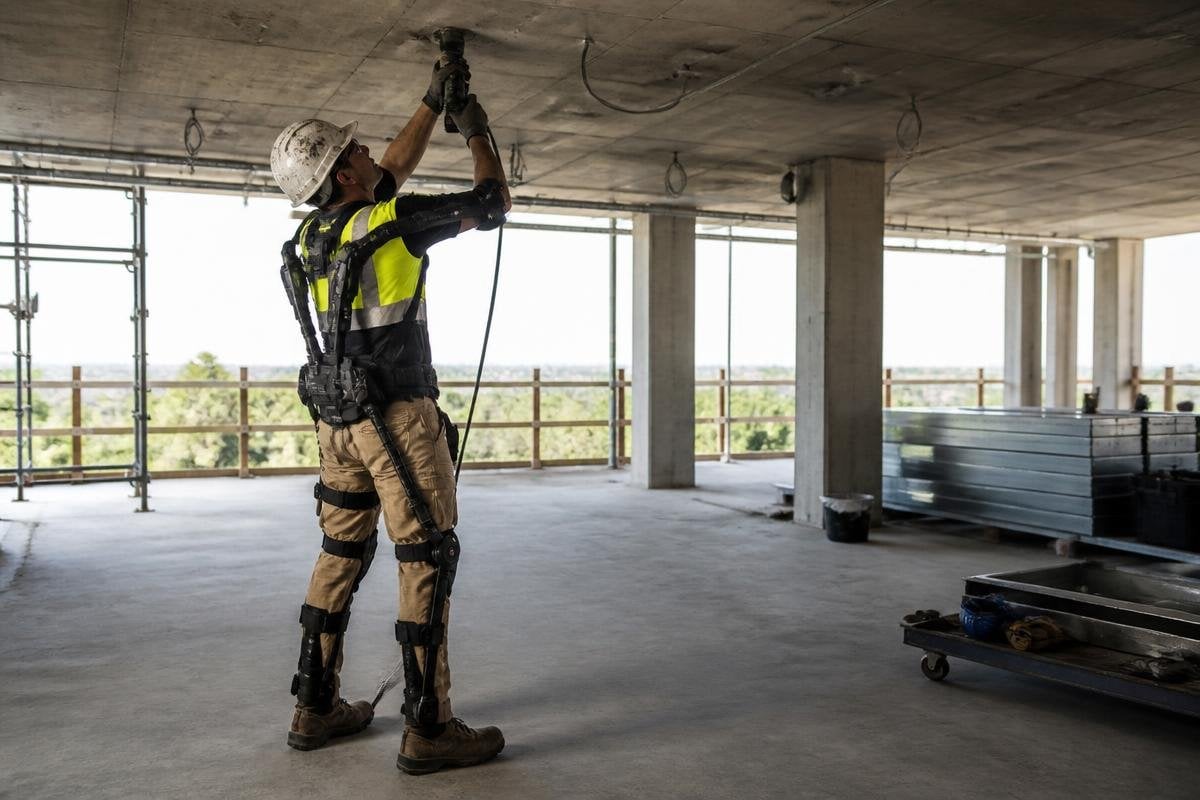
A construction exoskeleton can take part of a tool’s weight away from a worker’s arms, back, or legs. That could help during repeated overhead work, lifting, or long periods in a crouch, but the machine still has to fit the site.
- Support for repeated overhead tasks
- Less load carried by the worker’s body
- Limits set by fit, heat, movement, and power
Where an exoskeleton can help
An exoskeleton uses a frame, spring, motor, or a mix of these parts to carry load beside the body. The frame follows the worker’s movement while sending some force through a brace or support point instead of leaving the muscles to carry it alone.
That design suits work with repeated motions. A shoulder exoskeleton may hold a tool closer to its working height during overhead drilling. A back-support model may help keep the trunk in a safer position during lifts. A leg-support model may give the worker more help while standing from a squat.
The benefit depends on the task. A worker who changes position every few seconds may gain little from a device tuned for one posture. A task that keeps the arms raised for long periods gives the support system a clearer job.
The machine also changes how force moves through the body. If the frame presses against the hips, shoulders, or thighs, those contact points need a good fit. Poor contact can create pressure in a new place, which leaves the worker trading one source of strain for another.
The site creates hard limits
Construction sites are rough places for wearable machines. Dust, rain, mud, tight spaces, ladders, scaffolding, and loose materials all affect how a worker can move. A device that works beside a fixed workbench may become a problem when the worker must squeeze through a narrow opening.
Weight matters too. The worker carries the exoskeleton when its support is not needed, such as during a walk between work areas. A battery-powered model adds charging time and another part that can fail. A passive model, which uses springs or stored mechanical force instead of a motor, avoids that battery but may give less help across different tasks.
Fit takes time. Straps and braces need adjustment for clothing, body shape, and the work position. The device must stay clear of power tools, harnesses, gloves, and other protective gear. A poor fit can limit movement before the task even starts.
The fit problem is only the first test. A report from Robot 24 can place an exoskeleton’s claimed support beside the task, load, and work position it was tested against. That matters on a construction site, where stairs, ladders, tight spaces, and changing crews can turn a useful brace into another thing workers must manage.
What the machine cannot fix
An exoskeleton cannot remove the need for proper lifting methods, tool support, task rotation, or a better work layout. It also cannot make an unsafe load safe by itself. The worker still needs a clear view, stable footing, and enough room to release the tool or move away.
Training matters because the device changes body motion. A worker may need time to learn where the frame supports them and where it resists movement. Supervisors also need a plan for inspection, cleaning, charging, storage, and removal when the device does not suit a task.
Evidence must match the work. A lab test with one motion may show that a device lowers muscle effort during that motion. It does not prove that workers will finish a full shift with less fatigue, fewer injuries, or better output.
Those results need workplace trials that account for breaks, weather, tools, surfaces, and real task changes.
I’d treat an exoskeleton as task equipment, not as a replacement for fixing the task itself.
A buying and trial checklist
Before a construction team tests a device, they should:
- Name the repeated motion the device will support.
- Watch workers perform the task with their usual tools and protective gear.
- Check whether the frame limits ladders, stairs, crawling, or tight access.
- Record fitting time, battery needs, cleaning steps, and storage space.
- Ask how workers can remove the device during a fall, snag, or sudden task change.
- Measure comfort and movement across a full work period, not one short demonstration.
These checks connect the device to the work instead of treating the wearable frame as the answer on its own. A trial should also include workers who will use it, since a machine that slows movement or causes pressure will not help the task for long.
The next useful step is a site trial built around one repeated job, with records for fit, movement, interruptions, and worker comfort. If those results hold across real shifts, exoskeletons may earn a place beside the tools they were built to support.